Ebook Free The Mathematician's Mind, by Jacques Hadamard
Do you ever recognize guide The Mathematician's Mind, By Jacques Hadamard Yeah, this is an extremely appealing e-book to read. As we told recently, reading is not type of responsibility task to do when we need to obligate. Reviewing must be a habit, an excellent habit. By reading The Mathematician's Mind, By Jacques Hadamard, you could open up the new globe as well as obtain the power from the globe. Everything can be gained with the publication The Mathematician's Mind, By Jacques Hadamard Well in quick, book is really effective. As what we provide you here, this The Mathematician's Mind, By Jacques Hadamard is as one of checking out e-book for you.
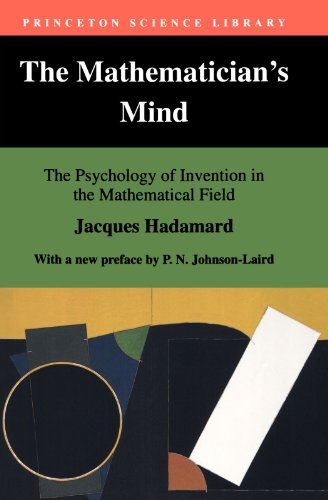
The Mathematician's Mind, by Jacques Hadamard

Ebook Free The Mathematician's Mind, by Jacques Hadamard
Reserve The Mathematician's Mind, By Jacques Hadamard is among the priceless worth that will make you constantly rich. It will not imply as rich as the cash provide you. When some individuals have absence to face the life, people with many e-books in some cases will be better in doing the life. Why need to be book The Mathematician's Mind, By Jacques Hadamard It is actually not suggested that e-book The Mathematician's Mind, By Jacques Hadamard will certainly offer you power to get to everything. Guide is to review and what we suggested is the book that is checked out. You can additionally see how guide entitles The Mathematician's Mind, By Jacques Hadamard and varieties of e-book collections are supplying below.
However right here, we will certainly show you amazing point to be able consistently read the e-book The Mathematician's Mind, By Jacques Hadamard anywhere and whenever you take place and also time. The publication The Mathematician's Mind, By Jacques Hadamard by simply could aid you to realize having guide to review every time. It won't obligate you to constantly bring the thick publication anywhere you go. You can just maintain them on the gizmo or on soft file in your computer to always check out the area during that time.
Yeah, hanging around to review guide The Mathematician's Mind, By Jacques Hadamard by on the internet could likewise provide you favorable session. It will relieve to talk in whatever condition. Through this could be much more interesting to do and also simpler to review. Now, to obtain this The Mathematician's Mind, By Jacques Hadamard, you can download and install in the web link that we provide. It will assist you to obtain very easy way to download the book The Mathematician's Mind, By Jacques Hadamard.
The e-books The Mathematician's Mind, By Jacques Hadamard, from simple to complicated one will certainly be a really helpful works that you can require to change your life. It will not provide you adverse declaration unless you do not get the meaning. This is definitely to do in checking out a book to overcome the meaning. Generally, this e-book entitled The Mathematician's Mind, By Jacques Hadamard is checked out due to the fact that you really similar to this sort of book. So, you can get easier to recognize the perception and meaning. Once even more to constantly remember is by reading this book The Mathematician's Mind, By Jacques Hadamard, you can fulfil hat your curiosity beginning by completing this reading publication.
Fifty years ago when Jacques Hadamard set out to explore how mathematicians invent new ideas, he considered the creative experiences of some of the greatest thinkers of his generation, such as George Polya, Claude Lévi-Strauss, and Albert Einstein. It appeared that inspiration could strike anytime, particularly after an individual had worked hard on a problem for days and then turned attention to another activity. In exploring this phenomenon, Hadamard produced one of the most famous and cogent cases for the existence of unconscious mental processes in mathematical invention and other forms of creativity. Written before the explosion of research in computers and cognitive science, his book, originally titled The Psychology of Invention in the Mathematical Field, remains an important tool for exploring the increasingly complex problem of mental life.
The roots of creativity for Hadamard lie not in consciousness, but in the long unconscious work of incubation, and in the unconscious aesthetic selection of ideas that thereby pass into consciousness. His discussion of this process comprises a wide range of topics, including the use of mental images or symbols, visualized or auditory words, "meaningless" words, logic, and intuition. Among the important documents collected is a letter from Albert Einstein analyzing his own mechanism of thought.
- Sales Rank: #1135209 in Books
- Published on: 1996-09-30
- Original language: English
- Number of items: 1
- Dimensions: 8.00" h x .38" w x 5.25" l, .45 pounds
- Binding: Paperback
- 166 pages
From the Publisher
Fifty years ago when Jacques Hadamard set out to explore how mathematicians invent new ideas, he considered the creative experiences of some of the greatest thinkers of his generation, such as George Polya, Claude LeviStrauss, and Albert Einstein. It appeared that inspiration could strike anytime, particularly after an individual had worked hard on a problem for days and then turned attention to another activity. In exploring this phenomenon, Hadamard produced one of the most famous and cogent cases for the existence of unconscious mental processes in mathematical invention and other forms of creativity. Written before the explosion of research in computers and cognitive science, his book, originally titled The Psychology of Invention in the Mathematical Field, remains an important tool for exploring the increasingly complex problem of mental life.
The roots of creativity for Hadamard lie not in consciousness, but in the long unconscious work of incubation, and in the unconscious aesthetic selection of ideas that thereby pass into consciousness. His discussion of this process comprises a wide range of topics, including the use of mental images or symbols, visualized or auditory words, "meaningless" words, logic, and intuition. Among the important documents collected is a letter from Albert Einstein analyzing his own mechanism of thought.
From the Back Cover
Fifty years ago when Jacques Hadamard set out to explore how mathematicians invent new ideas, he considered the creative experiences of some of the greatest thinkers of his generation, such as George Polya, Claude Levi-Strauss, and Albert Einstein. It appeared that inspiration could strike anytime, particularly after an individual had worked hard on a problem for days and then turned attention to another activity. In exploring this phenomenon, Hadamard produced one of the most famous and cogent cases for the existence of unconscious mental processes in mathematical invention and other forms of creativity.
Most helpful customer reviews
20 of 21 people found the following review helpful.
A study of the mental workings of some great mathematicians
By Mike Christie
This is a short study of how creative thought works. Hadamard, a world-class mathematician best known for his proof of the prime number theorem in 1896, wrote this in the 40's, basing it on correspondence with many of the great living mathematicians of his time. The actual questions he posed are preserved in an appendix.
Most of his respondents were mathematicians (and he limited his correspondence to the best minds in the field), but he did get information from several other fields, and cites data about physicists (a letter from Einstein forms another appendix), chemists, physiologists, metaphysicians, and so on. What he is trying to examine is a slippery subject, perhaps best explained by a quote. Here is a discussion of Sidgwick, an economist: "His reasonings on economic questions were almost always accompanied by images, and the images were often curiously arbitrary and sometimes almost undecipherably symbolic. For example, it took him a long time to discover that an odd symbolic image which accompanied the word 'value' was a faint, partial image of a man putting something on a scale."
Hadamard gives his own mental images that accompany his following through the steps of Euclid's famous proof of the infinitude of primes. I won't reproduce that here for space reasons, but the contrast with Sidgwick's--and with other reports of mental activity--is fascinating. Many other examples are given, from Mozart to Polya to Galton to Poincare. Hadamard makes it clear that language and thought are not the same thing, contrary to a commonly expressed view among linguists. He cites Max Muller's comments equating thought and language, and acknowledges that for Muller it may be so, but convincingly demonstrates, by quoting numerous other mathematicians, that it is not true for everyone. The further conclusion, that the process of creative thought, while following similar patterns in similar discipline, can vary dramatically, is as far as Hadamard can go with the data he has.
One other note: this book was originally titled "The Psychology of Invention in the Mathematical Field" and is available under that title from Amazon, published by Dover Books. It's not immediately clear from the Amazon page that this is so. The Dover edition is substantially cheaper.
A fascinating and informative book.
11 of 12 people found the following review helpful.
The Psychology of Math
By Bukkene Bruse
The Mathematician's Mind is a study on how research mathematicians go about the business of advancing their field. Jacques Hadamard, a prominent mathematician, wrote this psychology text over 50 years ago, after having done his best work 50 years prior. Although in some ways dated, both in content and in writing style, the book provides an interesting examination of the role of the conscious and subconscious in solving a problem, particularly the process of incubation and (seemingly) sudden inspiration. He brings up the roles intuition and logic play in the way various mathematicians go about their business. Hadamard also examines the influence of aesthetics in not just choosing a problem, but in solving it. He studies the choice of research direction, with the interesting comment that Hadamard himself avoided areas of research where there was already a great deal of activity.
The book is short enough that if the subject interests you, it is worth your time.
The text is also published under the title "The Psychology of Invention in the Mathematical Field."
15 of 16 people found the following review helpful.
The Psychology of Invention in the Mathematical Field
By Professor Joseph L. McCauley
Not only is this book fascinating, it's the only one of it's kind. The book has also proved very useful to me in life. As a graduate student I used Poincaré's implicit `advice' (described in the book) in the following way. In electrodynamics we had a long problem sheet to hand in every two weeks. I started by writing down answers to all problems that I knew. Then, I thought about the next-easiest problem each day walking twice to and from the University (about 1 1/2 hours altogether). When the answer came I wrote it down and iterated the process. Before the end of two weeks most of the problems (from Jackson) had been solved. Poincari's advice is very good about giving the unconscious a chance to work. Phooey and double phooey on the silly, uncreative skinner-box types and other behaviorists who don't recognize the unconscious as the source of creativity!
The Mathematician's Mind, by Jacques Hadamard PDF
The Mathematician's Mind, by Jacques Hadamard EPub
The Mathematician's Mind, by Jacques Hadamard Doc
The Mathematician's Mind, by Jacques Hadamard iBooks
The Mathematician's Mind, by Jacques Hadamard rtf
The Mathematician's Mind, by Jacques Hadamard Mobipocket
The Mathematician's Mind, by Jacques Hadamard Kindle


